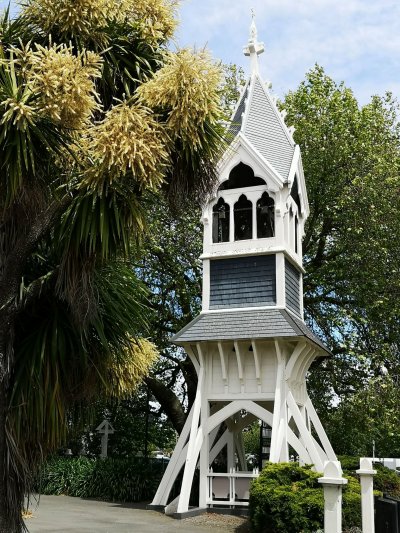
The Belfry today. Jonn Nicholson
175 years ago, the bell for Christchurch first rang out across the plains. The bell arrived in Lyttelton with the first Canterbury Association settlers in December 1850 (reports suggest it came on the Charlotte Jane), and along with an organ and some wood carvings was something of a consolation gift from the already struggling Canterbury Association. The bell was brought over from Lyttelton on 26 June 1851 and hung in a simple separate belfry in time for the opening of the second 'temporary' church and school building on 20 July. Its ringing provided a source of astonishment to the tangata whenua, and a link to the faraway country they'd left to the settlers.
The bell was the settlement's first timepiece and was rung every hour of daylight.
Marie Peter wrote that it served "not just as a church bell - summoning, apparently, Presbyterians and Wesleyans as well as Anglicans to worship - but also as an alarm and even more as a regulator of timepieces for the whole town. It thus fulfilled a long-established function of church bells in the leisurely days before 'railway time' and 'wireless time'."
Writing in the Lyttelton Times in 1852 a correspondent spoke of the bell in a report on the state of the fledgling settlement
"Sunday is, generally speaking, well observed. A large bell, hung temporarily a few feet from the ground, is heard 4 or 5 miles off with a fair wind; it is the tenor of a peal of bells, which are to be eventually sent hither, and thus its tone reminds one of " an English country church far better than the tinkling bells hitherto heard in New Zealand."
The bell can be seen hanging in its simple gantry in this sketch of the temporary second church made by Dr Barker
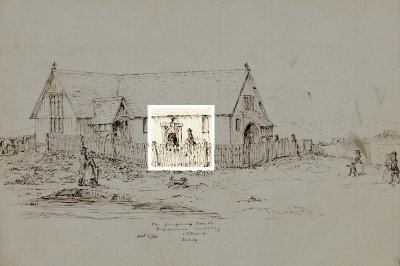
https://collection.canterburymuseum.com/objects/113827/sketch-the-temporary-church
Fire was a constant threat in the makeshift settlement and in 1858 on the occasion of a fire, the bell was "rung so vigorously that it was cracked" (The Star and had to be returned to the makers Messrs. Mears, of London to be recast.
On its return 15 months later, the bell weighed in at 1514 Ibs, some 40 Ibs. heavier than before and the St Michael's Churchwardens began the call for subscriptions to hang the bell in a proper manner, and out of the reach of mischievous and over enthusiastic hands. A call that was supported by the other Christian denominations and parishes.
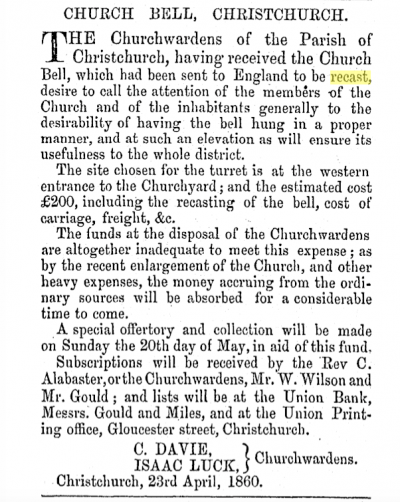
https://paperspast.natlib.govt.nz/newspapers/LT18600428.2.21.2

https://paperspast.natlib.govt.nz/newspapers/LT18600324.2.17.3
One of Christchurch's leading architects in the province of Canterbury, Benjamin Mountfort and his business partner, Isaac Luck, were commissioned to design the new belfry to house and protect the recast bell. This was sited at the western entrance to the 'Temporary' church right on Oxford Terrace.
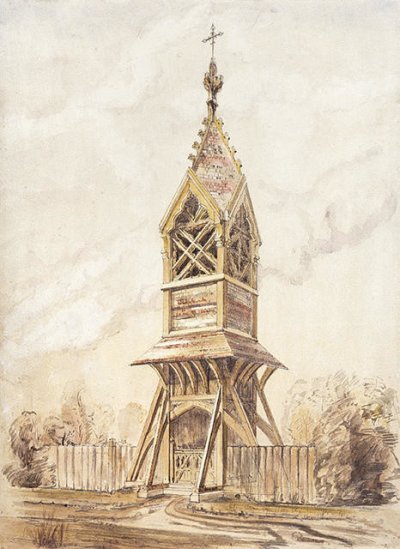
The proposed bell tower Benjamin
Mountfort. Property of the Parish, held in the Robert McDougall Art
Gallery Collection, exernal link
Enough money was raised to enable the bell to be hung in the unfinished turret and the Churchwardens announced the large bell would be rung for the first time on 8 September 1861, "being rung for two minutes at 8 o'clock, and 9 30 am. Also for a quarter of an hour preceding divine service, viz:-from 10 15 till 10 30 a.m., and from 5 45 till six o'clock p.m" (Press) Fundraising continued, and the Belfry was completed some ten years after the arrival of the first Canterbury Association settlers.
Reactions to the new belfry were inevitably mixed.
Mountfort designed the belfry in the Gothic revival style that reflected his High Church sympathies. Ian Lochhead wrote:
*The belfry was a colonial re-interpretation of the English tradition of free-standing timber bell towers that stretched back to medieval times. Mountfort was familiar with both medieval originals and the recently-published plans of wooden belfries from Scandinavia. The very distinctive Rhenish helm roof of Mountfort's belfry is derived from a rather different source, the Anglo-Saxon tower of St Mary's Church, Sompting in West Sussex. This church had been recently restored by R. C. Carpenter, the architect with whom Mountfort trained, and was particularly admired and imitated by Victorian architects.
For Mountfort, the Rhenish helm roof suggested a link between one of England's earliest surviving churches and the formative period of the Anglican church in Canterbury. These historical connections seem to have been lost on Mountfort's critics." (St Michael and All Angels Belfry, Ian Lochhead in St Michael and All Angels Christchurch Commemorating 150 years)
On 11 September 1861 the Lyttelton Times welcomed the still incomplete structure as "a great ornament to the town ... [it] already forms a pleasing object in the distant views of the city, as it stands well above the surrounding buildings" (Lyttleton Times).
Others like James Edward Fitzgerald were critical. Open timber construction and steeply pitched gables in the 1850s and 1860s, weren't favoured by low churchmen, and there was a taste for solid permanence in the growing town (Press). The new belfry stood in stark contrast to the makeshift church.
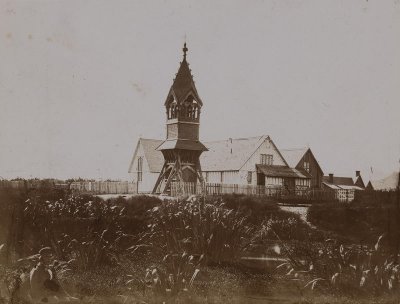
c1861, Canterbury Museum
With the limited resources available, Mountfort designed the turret to serve as both lych-gate and belfry. The tower's lych-gate function became obscured in time as the bottom was filled in to provide much needed storage, and possibly to restrict unwelcome access. In 1862 someone stole the clapper out of the bell and the churchwardens offered a five pounds reward, but the clapper was never recovered (Lyttleton Times).
The bell tower remained a magnet for mischief across the years. Many a vicarage resident from Dean Jacobs on was rudely awoken in the depths of the night by young people climbing in and ringing the bell vigorously.
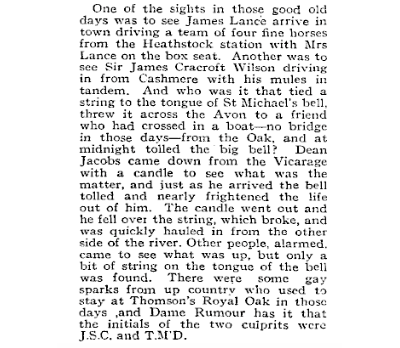
With the clapper replaced, the bell continued to serve as a fire bell for the southwest corner of the growing town (Lyttleton Times). In February 1908 fire broke out in Lichfield Street ravaging the High, Lichfield, Colombo and Cashel Street block and flying embers set fire to the belfry which was fortunately extinguished before serious damage could be done (Press).
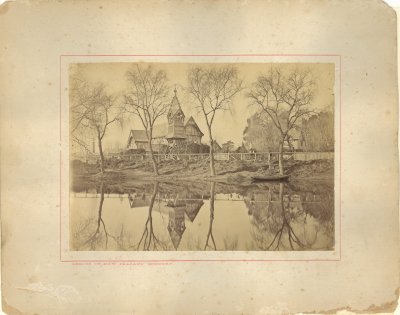
c1880 Christchurch-St Michael Parish
Archives PAR021 Christchurch Anglican Diocesan Archives
Soon after the erection of the Belfry the parish began considering replacing the temporary church with a larger permanent structure. Suggested replacement plans would have replaced the freestanding Belfry with an attached bell tower, and in 1869 plans drawn up by the diocesan architect William Crisp were adopted. Because of a funding shortfall it was decided to dispense with the bell tower planned for the southwest corner of the building for the time being. Continuing funding issues meant the tower was never built and the Belfry was saved from demolition providing a nice balance to the new Gothic Revival church building.
There it remained until 1976 when road-widening necessitated its shift to its present position, closer to the church.
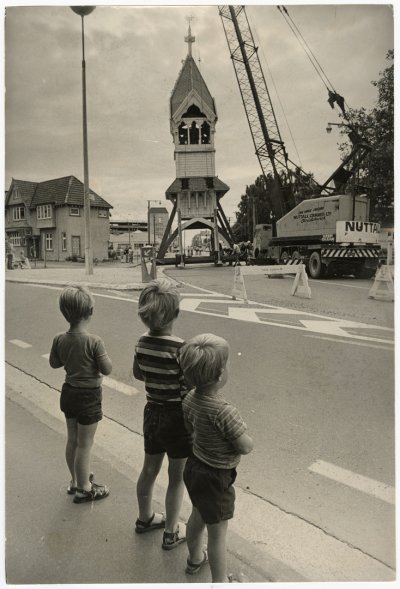
Canterbury Stories
(CCL-StarP-00650A), used with permission of CCL and Allied Media.
(source).
To move the Belfry work was undertaken to strengthen and refresh its appearance. Weatherboards had replaced the shingles below the bell chamber, and these were restored. The lower level was reopened, but the gates which had been hanging for many years on the open north porch of the church and were said to have come off the belfry were not reinstated. The original buttresses were replaced, bench seats were installed and the structure was set on new foundations. The straight edged metal sheet cladding installed on the roof in the 1960s was retained.
Fr Perry had introduced the praying of the Angelus in his time at St Michael's (1916-1936) and for many years the bell was rung daily at midday by the senior boys (and later girls) of the school to mark the Angelus.
Sr Annette CSN spoke of her time teaching in the late 1950s, "Every day at noon the Angelus was rung from the bell tower by one of the big boys in Std 6. At the first clear note of the 'angelbell' all activity in the classroom ceased as if by magic and eyes were closed and hands clasped in prayer. Each day began and ended with prayer. One afternoon, when the 'Amen' had burst from 56 young voices, a small boy said indignantly, 'Sister, I kept my eyes shut, but Jimmy's eyes were wide open all through prayers!' (In this Sign: An Outline of the Establishment of the School of S. Michael and All Angels*, Glennys Ward)
In time the bell was no longer needed as the timepiece for the settlement nor as a fire bell, but it continues to be a part of the life of the parish and to sound in the city. Its ringing calls worshippers to church daily and on Sundays, to celebrate weddings, and special occasions, and it is tolled at funerals. Each Sunday it is rung at the elevation in the communion service.
The Christchurch earthquakes silenced the bell for a time until a detailed report was commissioned in 2023 to assess its structural integrity. The Belfry was found to be still structurally sound but in need of repairs. Fundraising was initiated to further the necessary repairs and to conserve the Belfry to ensure its future.
Today the Belfry at St Michael's is an icon and link to the early years of European settlement. 165 years after it was built, it is one of the oldest buildings remaining from those early years, the second oldest building still standing tall on its original site in the central city, and one of the few still fulfilling its original function.
Jonn Nicholson, 2025
Sources
Christchurch-St Michael's: A Study in Anglicanism in New Zealand, 1851-1972 by Marie Peters
In this Sign: An Outline of the Establishment of the School of S. Michael and All Angels by Glennys Ward
Canterbury Museum images: No Known Copyright Restrictions Christchurch City Libraries and Allied Media Christchurch-St Michael Collection, Christchurch Anglican Diocesan Archives St Michael and All Angels Belfry by Ian Lochhead in St. Michael and All Angels, Christchurch: Commemorating 150 Years: Church and School 1851-2001
https://collection.canterburymuseum.com/explore
https://paperspast.natlib.govt.nz
Belfry of St Michael and All Angels Conservation Plan 2023 prepared by DPA Architects for The Vestry, St Michael and All Angels 2023