Founding St Michael and All Angels
2026 marks 175 years of continuous Christian worship on the St Michael’s Parish site. The story began when in November 1847, Edward Gibbon Wakefield persuaded an idealistic young Irishman, John Robert Godley, that together they could devise the best of all emigration schemes. The following year, in 1848, the Canterbury Association was formed to promote a special colony in New Zealand: an English society free from industrial slums and revolutionary unrest, sustained by an ideal Church of England.
Plans moved quickly. The Association’s land surveyors identified what they believed to be the ideal site for the proposed settlement of Canterbury and its chief town, Christchurch. Approval was secured and purchase terms agreed for land in the Canterbury region.
In September 1850, around 800 passengers assembled at Gravesend and set sail from Plymouth, England, in four ships—later commemorated in carved panels in the Pilgrim’s Chapel. These included colonists, who had the means to purchase land in the new settlement, and emigrants, mainly agricultural labourers, tradespeople, domestic servants, and young married couples. The ships arrived in Lyttelton between 16 and 27 December 1850.
After the long voyage, it was not until January 1851 that most settlers began the arduous journey over the Port Hills to the plains and the unformed village of Christchurch. At that time, the town’s streets existed only as swathes cut through the fern. Many of the new arrivals constructed the standard early shelter known as the V-hut: “a mere sloping roof of boards overlapping, set on the ground without any walls to stand on.”
Central to the Canterbury Association’s vision of “a good and right state of Society” were its religious and educational schemes. A levy on land sales was intended to fund ecclesiastical and educational institutions, which in Canterbury were to be exclusively Anglican. St Michael’s—then known simply as the Church at Christchurch—was a key part of this plan.
Bishop Selwyn, Bishop of the then undivided Diocese of New Zealand, visited Canterbury in January and February 1851. During his visit, he licensed the Reverend G. T. B. Kingdon, who had travelled out as chaplain on one of the first ships, the Charlotte Jane, to the cure of Christchurch. Towards the end of January, Kingdon himself crossed the hills to the plains bringing the communion vessels gifted by the Canterbury Association and used on board ship, on the long journey, and to this day at St Michael’s.

Kingdon and his wife were provided with a V-hut on land reserved by the Association for church purposes, near the river on either side of what would become Lichfield Street. From the same period, regular church services were held in another V-hut on the site. The “floor” was simply burnt-off ground, with charred stalks of toi-toi still protruding. The “seats” were boards nailed to stakes, packing cases covered with canvas served as an altar, and casks, sacks, and spades were stacked in the corners. By the end of February, a flag hoisted on a flagstaff outside the hut signalled when services were to be held.
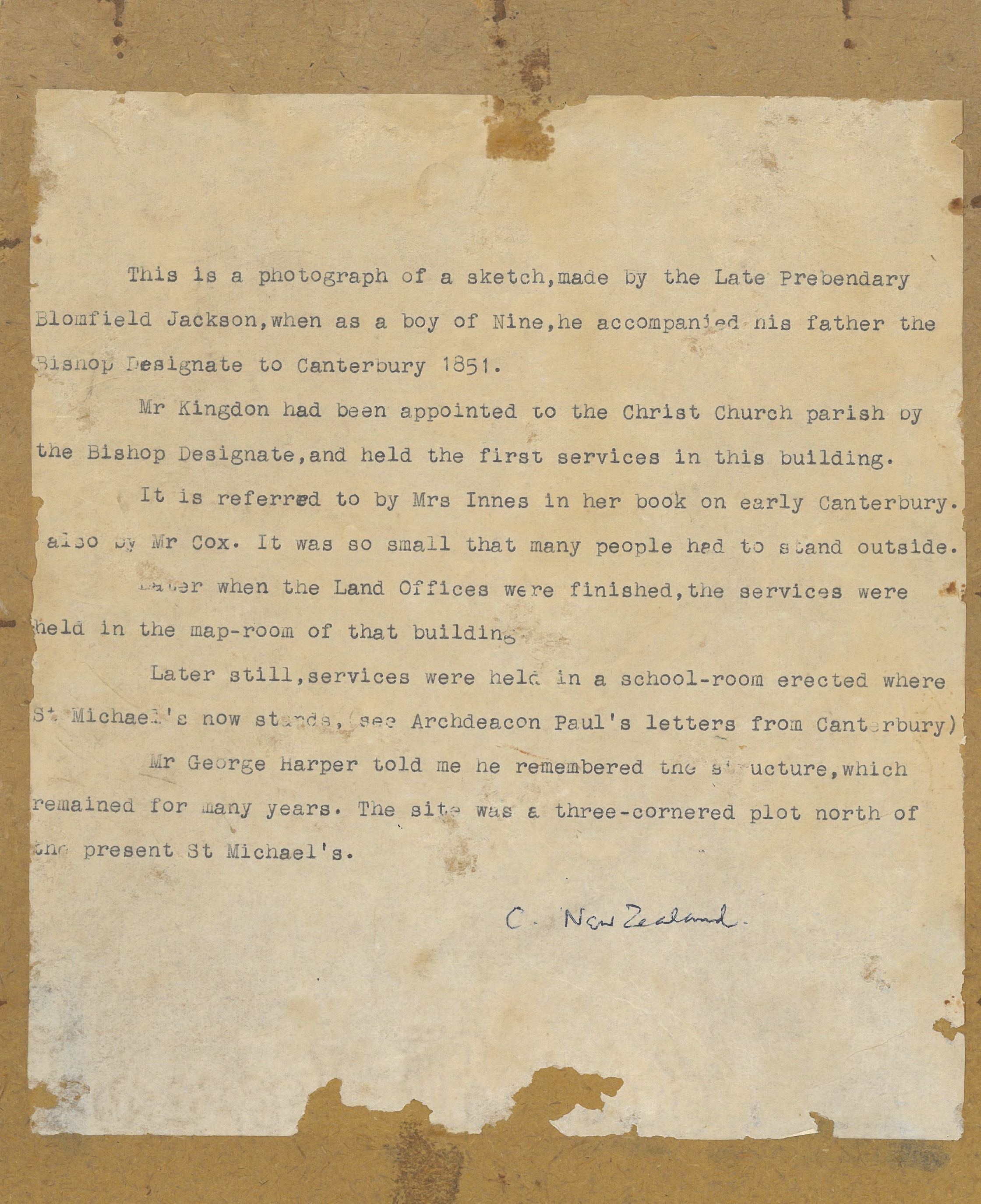
This building soon proved too small for the growing population, and many worshippers were forced to remain outside during services. By 28 February 1851, John Robert Godley, as Agent for the Canterbury Association, was calling for tenders for the construction of a temporary church. In the meantime, some services were also held in the larger Land Office.
For more information, see Rev. Michael Blain's article on the Canterbury Association, firstfourships.nz, Marie Peter's book Christchurch-St Michael's: A Study in Anglicanism in New Zealand, 1851-1972, and material on John Robert Godly available through the Christchurch City Libraries website.
Johnann Williams
Images are from Christchurch-St Michael Collection, Christchurch Anglican Diocesan Archives PAR021, with thanks to Jane Teal.